Showing posts with label Literacy. Show all posts

Friday, January 18, 2013

Day and Night Forests, p.s. there's glitter


This week we conducted a comparative study of these books...Baba Yaga and the Wise Doll adapted by Oran Hiawyn and illustrated by Ruth Brown (love, love her illustrations and the Leaves LOVE her book, Toad), Babushka Baba Yaga by Patricia Polacco (I am, personally, not a fan of this book, but that is the adult-me talking), and we are now in the middle of Anna and The Seven Swans but Maida Silverman. We read the Wise Doll on Monday because it set up the project for the day perfectly. The children have been working on day and night paintings and last week they collaged trees onto their night backgrounds. These books show three versions of "forest" and the children are creating their own story illustrations. 
The children are adding watercolor paint on top (and beside) the tempera paint.  

We talked about how if the trees are close together or are leaning, the forest appears scarier to a small child (we will revisit this again when we work on the stories next week). Merrick's trees grow so close together that you can only see a hint of the full moon behind them. The trees are also dark in grays, black, and purple. On Monday, they will collage the trees onto their day sky. In case you are wondering why these projects are spaced just so, it is because the backgrounds are layered tempera and watercolor. When a glue wash is applied to these (especially the watercolor) the paint AND the paper used for the trees will bleed. Since each sky and trees feature different shades, the glue and the glue brushes would carry those colors with them and by the time the last children began their projects, their colors would no longer be their own.


Oh and p.s. there has to be glitter.


Sunday, October 28, 2012

Worm Tales

In the 3- and 4-year old class, we often work on lots and lots of collage projects. Painted paper works best as both background and layering components because it seems to have a heftier feeling and are easily managed by small fingers. Painted paper also often has two sides -- a painted side and unpainted side. This means the children have options within the context of the cut shape. We find it helpful to use collage pieces as basis for story lines, not just with materials, but also as launch points for actual stories.

The simple, yet instantly familiar, shapes of mud, water, and worms served well. The children learned more about process, technique, and the vocabulary of creating a collage And in this collage, they discovered how to illustrate a story of their own creation.

The children painted mud backgrounds, choosing paint shades that spoke for their vision of what mud should look like. Think about it...is mud brown? Not always. The water and worm pieces are painted paper scraps.


Saturday, December 3, 2011

Negative Space, Mudcloth Redux

Since the primary focus of the 3- and 4-year olds' mudcloth project was STORY, I supplied a big batch of cut outs for them to choose from to help shape their tales. I cut many more than were necessary so that there was a lot of choice.

After cutting, I landed with a whole collection of negative space pieces that were too delicious to walk away from...these were dumped out on the table later for the 4- and 5-year olds to use for collage and then once the glue was dry, painting -- a study in double negative space! It will be interesting to find out what the STORY is for these works!


Wednesday, November 16, 2011

Mudcloth, Part IV (Maybe it IS More Than Paint)

The more time we spent with the beautiful mudcloth fabrics sent in by the McDougall-Langes, the more I thought about COLOR. The children have already told their stories. These are written on the backs of the pieces waiting to be transferred to computer and then card stock for mounting and display. We took a quick detour to revisit the patterns and added watercolor. The watercolor is vibrant enough to add color, but not enough to cover the texture of the ball painting.


Monday, November 14, 2011

Mudcloth, Part II

The golfball-painted backgrounds for the mudcloth are all dry. It was time to work out the foreground. This is a project for the 3- and 4-year olds and the primary goal is actually storytelling. The children record journal entries each week, but some art projects lend themselves perfectly for a little extra storytelling inspired by the books we are reading in class. Mudcloth tells a story with pattern, line, and placement.

While there is room for learning about art techniques (collage, in this case), this particular project is about exploring story.

The children chose their foregrounds from a collection of many cut outs and as they spread glue and sealed the surface of the collages, they talked about the story lines they imagined the shapes of their cut outs would tell.

Tomorrow we will begin to record these stories before adding watercolor to the collages.


Thursday, November 3, 2011

Tell a Story, Symbol Collage

Literacy. Symbol holds meaning. We begin by discussion the work of Gerald McDermott. His illustrations, with their vibrant colors and use of shapes, resonate with the children. They have symbols (leaf shapes and color teams) and the characters in several of McDermott's books are identifiable by their symbols (see Old Man Crow in Blue Coyote and the raven in Raven.) 

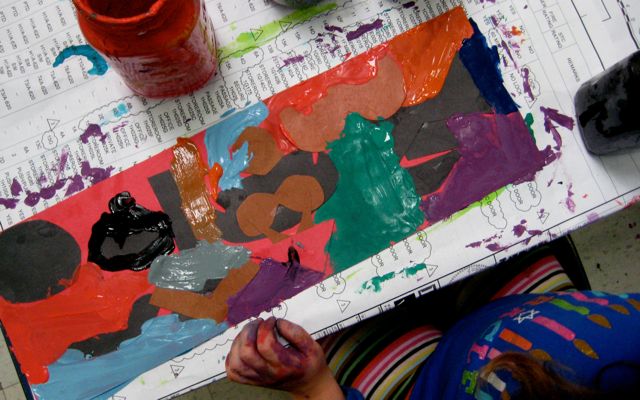
Using left-over painted paper shapes from another project, the children created their own geometric symbol pictures. The backgrounds are pink, similar to the sky in Jabuti.

The project's look twice -- this is what we call bringing children back to their work for reflection --here it is found in the titling. Here we discover a celebration of ideas and connections to the books we have read and the idea of Symbol.

A story begins.
Stories unfold.
Another story begins. Process hint: Do you have children who do not like glue
on their fingers? Place a damp washrag next to them while they work.
Glue simply wipes off.
A pattern story
Displayed work and project documentation. To learn more about how we display
children's work, please visit the
Growing Together blog, If These Walls Could Talk.
Displayed work and project documentation
Close-up of project documentation

Monday, October 24, 2011

Book Connection, Collage

The bright colors and graphic quality of Gerald McDermott's trickster tales and folk tales are like eye candy for children. As teachers, we can find shape, pattern, and symbol throughout these books, not to mention interesting discussion points. I think of these as math books first because of symbol. The children have symbols and these characters have symbols as well.

We read Jabuti, The Tortoise today. Last week, we read about Blue Coyote, Raven, and Zomo the Rabbit. Next up, Arrow to the Sun. This last is a good one for dramatic play, but I like the colors the best and I get to bring in my corn maiden doll to share. Since we have shared enough of the books to get a sense of symbol and shape, it made sense to make some story pictures of our own.

So out came the glue wash applied with foam brushes against a bright pink background. Using left-over painted paper from an earlier project will give the finished pieces some extra visual interest. We will use these collages to illustrate stories of the children's own invention.